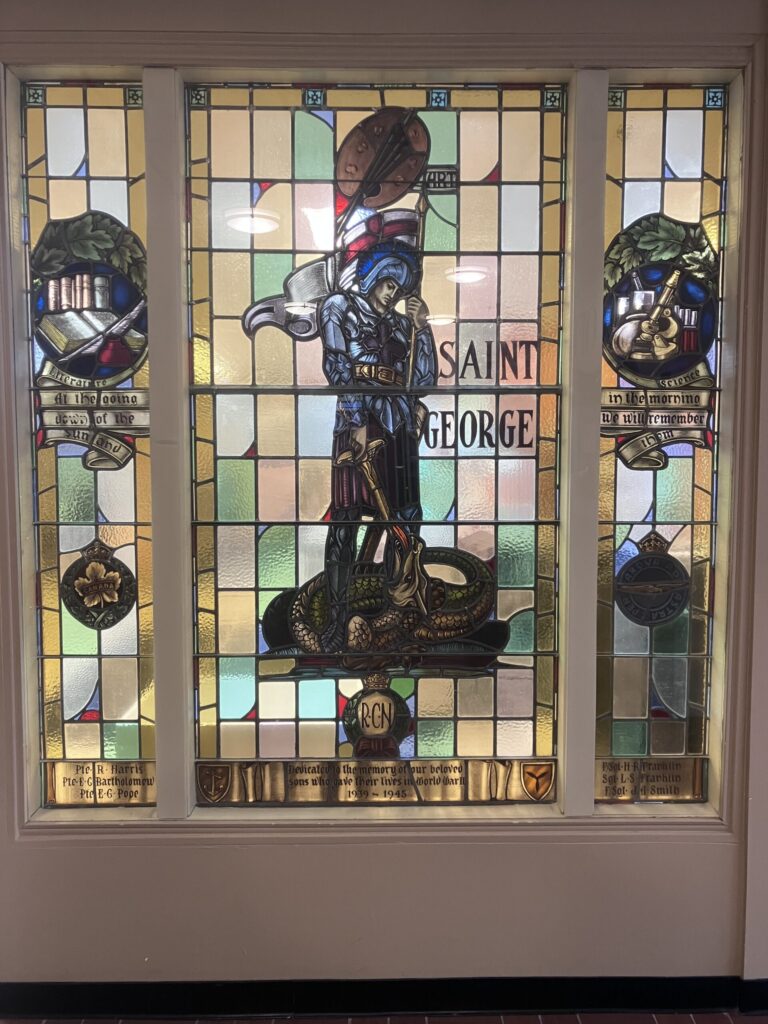
The poppies that decorate properties and lapels every November remind us of those who made the ultimate sacrifice to defend their country during times of war. The commemorative window in the Elgin County Library in Port Stanley expresses this message all year around. The memorial window, created around seventy-five years ago, shows an image of the Saint George, the patron saint of England, dressed in medieval battle gear piercing a dragon with a sword. In his left hand he holds a white banner marked with a red cross, called the Cross of Saint George, which has been associated with England since the early Middle Ages. Saint George has long been held up as an ideal of military strength and valor. According to tradition he was a soldier in the Roman Army in the early 4th century who was martyred for his Christianity. Medieval legends tell how he displayed his bravery by rescuing the Princess of Libya from a fierce, fire-breathing dragon. There is a long tradition of his name being invoked by warriors dating back to the Crusades in the 12th century when he was sometimes believed to appear and fight among them.
Saint George’s image was a common subject for Canadian and British memorials commemorating the heroism of fallen military personal who fought in World War I and II. For instance, images of Saint George appear in the Memorial Chapel of the Canadian Parliament’s Hall of Honour (formerly the Hall of Fame) and the War Memorial Window at Western University in London. Notable examples in England appear in Westminster Abbey and Norwich cathedral.
In the Saint George window in Port Stanley the warrior saint is surrounded by the insignia of the Royal Canadian Navy (RCN) and the Royal Airforce (RAF) with its motto, “Per ardua ad astra” (Through adversity to the stars) and Canada, represented by a crowned maple leaf. These motifs link the long tradition of the military valour represented by Saint George to the modern heroism of the six Port Stanley service men who are memorialized by the window. The names of these men who lost their lives in the service of the country in World War II are inscribed at the bottom of the window: brothers, F. Sgt. Harold R. and F. Sgt. Lloyd S. Franklin, Pte. Edward (Ted) Bartholomew, Pte. Ernest G. Pope, Pte. Ronald Hariss and F. Sgt. James (Bud) Smith. An inscription higher in the window affirms that, “In the going down of the sun and in the morning, we will remember them.”
The families of the fallen soldiers paid about $700 for the window in the 1950s which would be a little over $8,000 in today’s currency. Composed of over 200 pieces, the Saint George window was designed by artist Frank Ramsdale of Markham and created by Robert Edwards and his son Arthur at Edwards Glass Company in London. It was originally installed in the old Port Stanley Memorial Library in the wall facing the harbor so that it was easily seen from both inside the library and by sailors coming into port. The window was restored, rededicated and reinstalled in the new Port Stanley branch of the Elgin County Library in August 1981. It was placed at the entrance to the library in the lobby shared with the Port Stanley Festival Theatre ensuring that it has a wide audience of viewers.
There is an idiosyncratic feature of the Port Stanley window which makes it unusual within the broader context of Saint George memorial windows, but which links it to its local placement. Three of the window’s motifs seem to relate to the categories of knowledge found in the library. One shows an open book, a quill pen and shelf of books and is identified as “Literature.” The name Plato is clearly readable on the spine of one of the books. A second motif, labelled “Art”, depicts an artist’s palette and brushes. While a third, showing a microscope, test tubes and beakers, bears the inscription, “Science.” Perhaps these motifs make oblique reference to the freedom to inquire, experiment, create and access all types of knowledge for which those commemorated in the window fought.